Seven Ladles Deep: A Week on the Town’s Volunteer Soup Trail
On a wet Monday in mid-November 2026, I set out with a bus pass, a notebook and a fairly serious appetite. The plan was simple: follow the town’s volunteer soup lunches for a week, not as a critic but as a curious resident. No reservations, no tasting notes, no scoring. Just a route through church halls, scout huts and community centres, and a question I kept scribbling in the margin: what does a bowl of soup actually do?
The answer, it turns out, is rarely just about soup. It is about radiators that work, chairs arranged so nobody has to sit alone, and volunteers who remember that you take your tea strong and your bread without butter.
Monday: The Church Hall with the Good Radiators
St Aidan’s hall opens at 11.30, but the first volunteers are in by 9.15. The urn is on, the long tables are out, and someone is wrestling a folding chair that has clearly seen things. Today’s soup is leek and potato, with a bread roll, a slice of cheese and as much tea as you can reasonably drink. Suggested donation: £2. Nobody is turned away, and nobody is asked to explain why they are there.
The room fills in waves. First the regulars, who have their preferred seats. Then a few parents with toddlers, escaping the park. Then a couple of shift workers who finish at 10 and come for something hot before bed. By noon it is noisy in the way that church halls do best: crockery, catch-ups and the occasional scrape of a chair.
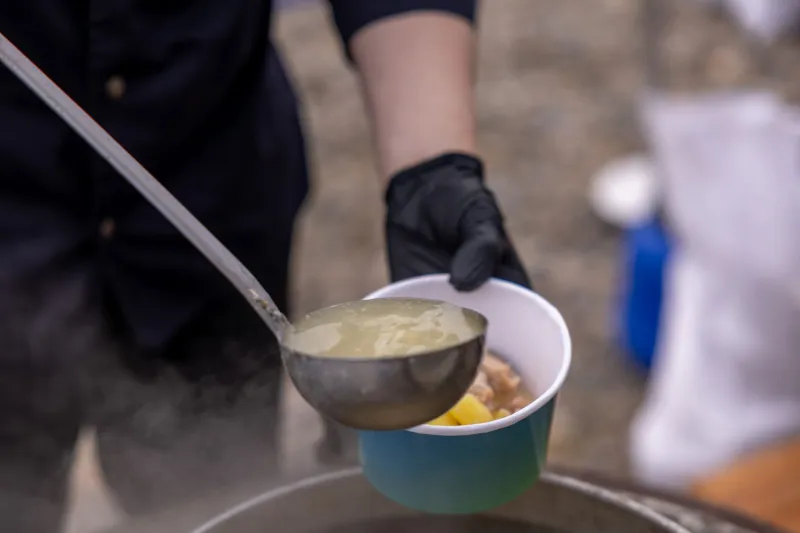
What struck me was the low-key efficiency of it. No sign-in sheet, no means testing, no awkward conversation about money. A jar by the door. A volunteer with a ladle. A rota on the wall with names crossed out and added in biro. It is civic life at its least glamorous and most useful.
Tuesday: The Scout Hut That Smells of Toast
The 4th Scout Hut is smaller, draughtier and smells faintly of toast. Tuesday’s lunch runs from 12 to 1.30 and is aimed at anyone who fancies company. Cost: £1.50, or free if you are skint. The soup is tomato and red lentil, served with a cheese toastie cut into triangles. There is a stack of board games by the window and a box of jigsaws with three missing pieces.
This is the stop where people linger longest. A retired teacher and a young dad get stuck into a jigsaw. Two women compare hip appointments. A teenager quietly does homework in the corner while his mum chats. Nobody is performing neighbourliness; they are just getting on with it.
I asked one volunteer what the lunch is for. She thought for a moment. ‘It’s for anyone who doesn’t want to eat a sandwich over the sink,’ she said. That felt like the most honest answer of the week.
Wednesday: The Community Centre with the Pay-As-You-Can Jar
The Riverside Community Centre is the biggest stop on the circuit. Wednesday lunch is run by a rotating team of volunteers, with support from the local food hub. Soup is squash and ginger, with a choice of bread or a warmed flatbread. Pay-as-you-can: no fixed price, no commentary.
The room is bright and a bit echoey. There is a designated quiet table near the window, which is a small but thoughtful touch. The volunteer co-ordinator tells me they serve between 40 and 70 people depending on the weather. ‘If it rains, we’re busier,’ she says. ‘If it’s sunny, people go to the park. We don’t take it personally.’
What I noticed here was the quiet admin of care. An allergen sheet on the wall. A box of reading glasses someone donated. A phone charger on the windowsill. A volunteer checking whether an older regular had managed to get her heating sorted. None of it was on the poster. All of it was the point.
Thursday: The Sheltered Housing Lounge
Thursday’s lunch is in the lounge of a sheltered housing scheme, open to residents and their guests. Soup: chicken and barley, with a roll. Cost: £3, which includes pudding — usually something with custard. It is the most traditional stop of the week, and the most gently formal. Tables are set with cutlery. There is a raffle.
The room is warm and a little cramped. A volunteer tells me the lunch started as a monthly coffee morning and grew legs. Now it runs weekly from October to March. ‘It’s not just the food,’ she says. ‘It’s knowing there’s a Thursday.’
I sat next to a man who had lived in the scheme for two years and knew almost everyone’s business. He told me the soup was better than the pub’s. He also told me which bus to get to the Tuesday scout hut, in case I had missed it. I had not, but I appreciated the routing advice.
Friday: The Old Library Room
The week ends in the old library room, a handsome space with high windows and a slightly chaotic serving hatch. Friday lunch is run by a group of volunteers who describe themselves, cheerfully, as ‘not a proper organisation’. Soup is carrot and coriander, with bread and a slice of cake. Cost: £2.50, or free for anyone who needs it.
The crowd is mixed: older residents, a few students, a family who have recently moved to the area, a man who says he comes for the cake and stays for the conversation. A volunteer with a clipboard is quietly checking whether anyone needs a lift home. Another is bagging up leftover bread for people to take away.
It is the last stop, and the most reflective. By Friday, I had eaten five bowls of soup and had roughly five hundred small conversations. I had also seen the same faces cropping up across the week — volunteers who do two shifts, regulars who follow the circuit, people who come for the food and stay for the company.
What a Bowl Actually Costs
On paper, the soup circuit is cheap. Donations range from nothing to a fiver. The ingredients are often donated, redirected or bought with small grants. The halls are usually already there, with heating that has to be on anyway. But the real cost is volunteer time: chopping, stirring, washing up, putting out chairs, remembering names.
That time is not free, even when it is freely given. It is a quiet form of local infrastructure, and it works because it is low-demand. You do not have to qualify. You do not have to book. You do not have to explain yourself. You just turn up, pay what you can, and sit down.
The Warmth Between the Tables
In 2026, we talk a lot about loneliness and wellbeing, often in the language of policy and programmes. The soup circuit does not use that language. It uses ladles and urns and a rota on the wall. It tackles winter isolation not with a strategy document but with a bowl of something hot and a chair pulled out for you.
Is it enough? No. It will not fix housing, transport or the cost of heating. But it does something smaller and more immediate: it makes a cold week feel less sharp-edged. It turns a hall into a haven for an hour. It gives people a reason to leave the house on a Tuesday.
And it reveals something about belonging that is easy to forget: sometimes the most civic thing you can do is make too much soup and leave the door open.
A Practical Route for a Cold Week
If you fancy following the circuit, the details are usually on noticeboards, in church newsletters and on the community centre’s window. Most lunches run from late October to March. No need to book. Bring a friend, or come alone. Take a mug if you have one, though there are always spares. And if you can, put a pound in the jar — not because you have to, but because it keeps the urn on for the next person.