The Longest Growing Season: Notes from the Town's Allotment Queue
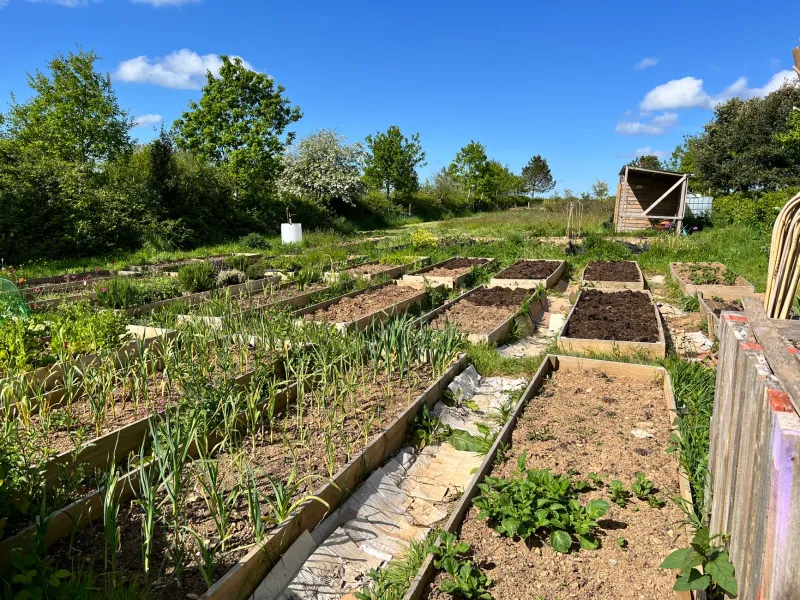
There's a gate on one of the town's allotment sites that sticks in wet weather. You lift it, shoulder it, and then — this is the important part — put it back exactly the way you found it. Nobody has ever written that on a sign. You learn it in your first week, usually from someone leaning on a fork who has been there since half seven.
That gate is as good a place as any to start thinking about allotments in 2026. Not the prize marrows, not the polytunnels, but the small unspoken rules of a shared place — and the long, quiet queue of people outside it, waiting for a key.
A scruffy sort of heritage
Allotments don't look like heritage. There's no interpretation board, no volunteer in a waistcoat, no gift shop. What you get is a patchwork of sheds in eleven shades of felt, a water butt held together with hope, and paths that someone has clearly been edging for decades out of pure stubbornness.
And yet the history is right there in the layout. Most UK allotment sites trace back to a mix of Victorian and Edwardian provision, parish land, and later plots carved out for returning soldiers and wartime food campaigns. The Allotments Acts of 1908 and 1925 gave plot-holders a degree of legal footing that still shapes how councils manage sites today. The names of the plots on our local registers — some of them, anyway — go back far enough that families have grown on the same strip across three generations.
What that means practically is that an allotment is one of the few places in town where heritage isn't curated. It's handed over, muddy, along with a set of seed-saving habits and a warning about the corner that floods.
Who's waiting, and why
Ask around the sites and the same themes come up. People want to grow something they can eat. They want a few hours a week where their phone is in a shed. They want somewhere to be outside that isn't a gym or a retail park. Some are parents looking for a Saturday activity that doesn't cost twenty pounds a head. Some are retired and want a reason to leave the house at eight in the morning. Increasingly, some are younger households on tight budgets, doing the sums on a bag of potatoes versus a packet of seed.
The waiting list, in other words, isn't really a list of gardeners. It's a list of people looking for space — physical space, yes, but also mental space, social space, and a slightly more affordable way to eat.
What the list actually measures
It's tempting to read a long waiting list purely as scarcity: too many applicants, not enough plots. That's true, but it's the dullest true thing about it.
A better reading is that the queue is a kind of civic patience made visible. Most people join it knowing they could wait years. They stay on it. They turn up to open days. They volunteer for a work party on a plot that isn't theirs. Something about that is quietly hopeful — a queue of people saying I would like to belong here, and I'm prepared to wait my turn.
There is a fairer, franker conversation to be had about how these lists are ordered. Should long-standing local residents get priority? Should new applicants from flats without gardens be weighted up? Should half-plots be offered more often so more households get a foothold? Every site committee you talk to has a different answer, and probably all of them are partly right.
Five things worth knowing before you apply
- Ask about plot size. The old measure was ten rods — roughly 250 square metres — but many sites now split plots. A half-plot is plenty for a first year, and honestly plenty for a fourth year too.
- Visit before you commit. Turn up on a Saturday, walk the site, note where the water is, where the shade sits, and which way the wind comes through.
- Check the rent and the rules. Rents are usually modest, but there may be a joining fee, a key deposit, and expectations about cultivation — most tenancy agreements require a plot to be kept productive, not just occupied.
- Look for a site association. Where one exists, the committee is your fastest source of honest information about waiting times. Ask them directly, and ask about turnover.
- Don't wait passively. Community gardens, churchyard growing beds, school plots and friends' overgrown corners all offer practice. Skills learned on someone else's patch transfer very well.
The scruffiness is the point
Something that strikes you after an hour on site is how un-designed it all is. There's a pallet fence, a bench made from a door, a sign painted by a child in 2019. Compared with the polished public realm of most town centres, allotments are gloriously unresolved.
That looseness is doing real work. It gives people permission to be beginners in public. It gives them a place to make mistakes — the failed brassica, the leeks that bolted — without an audience. For wellbeing, that's worth more than it sounds. Being a novice at something, outdoors, alongside other novices, is a reliable route out of your own head.
If you're on the list, keep the gate oiled
For those currently sitting on a waiting list, a mild suggestion: stay visible. Reply to the emails. Go to the open day even when it drizzles. Offer to help with the hedge cut. When a plot comes free, committees tend to think first of the person they've actually met — not out of favouritism, but because they've seen you. Patience is easier to sustain when it has a Saturday in it.
And if you're lucky enough to already have a key, the rest of us would politely like a word about that gate.