The Letters Above the Shops: A 2026 Ghost-Sign Walk for Curious Eyes
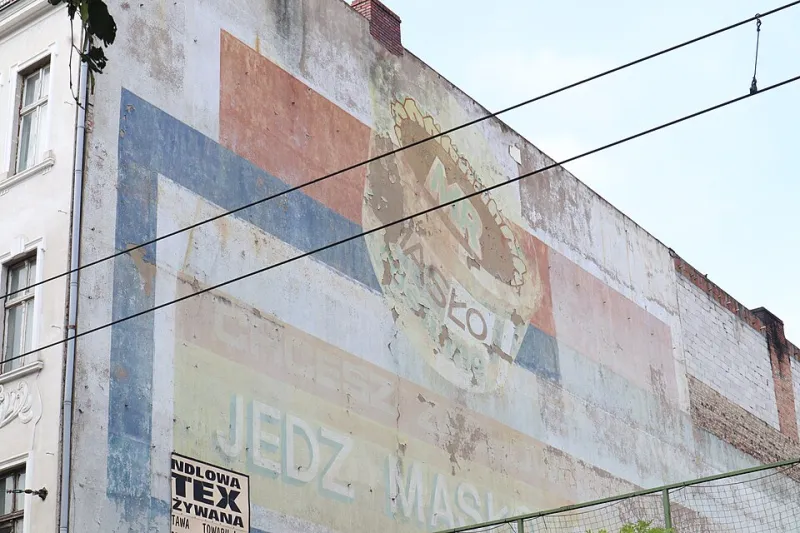
Photo: GeoMancer448, CC BY-SA 4.0, via Wikimedia Commons
Stand on almost any older high street and the eye goes to the ground floor: the bakery queue, the charity-shop window, the bus that is either coming or definitely not. Look up, though, and another street appears. Long after the shopkeepers have gone, their painted promises remain on the brickwork — tea dealers, cycle agents, family grocers, tobacco sellers and firms that once thought their name would never fade.
These are ghost signs: old hand-painted advertisements on buildings, often from the late Victorian period through to the mid-twentieth century. Some are bold and obvious. Others are barely a stain, a pale shadow behind a drainpipe. Once you start noticing them, a familiar high street becomes a layer cake of trades, letterforms and half-finished stories.
Start With a Slow Look Up
You do not need a guided tour or a special permit to begin. Pick a stretch of high street with older buildings — near a market place, station road or parish church is often a good bet — and give yourself forty-five minutes to walk perhaps two hundred metres. That sounds absurdly slow. That is the point.
Stand on the opposite pavement, not directly beneath the wall, and look at the upper storeys. Painted signs were often placed where they could be read from a distance, above awnings and between windows. Use your phone camera zoom as a makeshift telescope, but keep your feet on the ground and your shoulders out of the delivery route.
Light matters. Early morning or late afternoon can bring out lettering that vanishes in flat midday sun. Wet brick sometimes deepens the contrast. If a sign looks like a smear of grey, try viewing it from an angle; old paint often survives best where a later wall or roofline has sheltered it.
Carry a small notebook or use your phone. Note the words you can read, the colours you can guess, the shape of the letters and the building number. Do not touch the wall, scratch at the paint or assume the surface is stable. Curiosity should leave no mark.
What the Paint Can Tell You
A ghost sign is not just a decorative leftover. It is evidence. The wording might name a product, a trade or a proprietor. It might say licensed to sell tobacco, or mention teas and coffees, or advertise a cycle agent who also repaired radios. These small details can date a building’s commercial life and show how a high street adapted.
The lettering itself is a clue. Bold block capitals, looping scripts, gilded shadows and careful underlining all had their moment. Signwriters worked by hand, often without a template, and their styles travelled with them from job to job. A sign that looks clumsy to modern eyes may simply be weathered; a sign that looks elegant may have been repainted many times.
Layers are especially revealing. Look for one name painted over another, or a later shopfront cut into an earlier advert. A bricked-up doorway, a changed roofline or a modern extractor fan can all interrupt the original composition. None of this is a precise science, and it is worth saying so. Local history is full of confident guesses. The good ones are checked against trade directories, old maps, photographs and the memories of people who worked nearby.
Your local library or archive may hold rate books, street directories and old newspapers. A historical society might already have a photographic record. If you find a name, search it alongside the street name and the approximate decade. You may discover that the grocer became a bicycle shop, then a printer, then a charity shop — a whole small economic history in one façade.
The Wellbeing Bit, Without the Woo
Slow noticing is having a moment, and for once the fuss is fairly sensible. A gentle walk with a specific task — finding faded letters — gives the brain something mild and absorbing to do. It interrupts the usual hurry. It makes a street feel less like a corridor and more like a place with a past.
There is a civic side to this too. When you can name what is distinctive about your high street, you are more likely to notice when it is under pressure. Ghost signs are not a reason to oppose every change; towns are not museums. But they are a handy reminder that the built environment is shared memory, not just a backdrop for bins day.
Try it with a friend, a neighbour or a willing teenager. Compare notes. Argue gently about whether the faded word says cocoa or cycles. The wellbeing benefit is not in achieving an answer. It is in the looking, the wondering and the small shared act of paying attention.
Keeping Them Without Freezing the Street
The ethics of ghost signs are trickier than they first appear. A faded advert can be beautiful precisely because it is faded. Aggressive repainting may erase the texture that made it interesting, while doing nothing may let weather finish the job. Conservation advice usually favours minimal intervention, breathable materials and specialist knowledge, especially on older or listed buildings. If a sign is on your own property, speak to the local conservation officer before reaching for a brush.
There is also a wider question. Do we preserve every old advert because it is old, or do we accept that some will disappear as buildings are repaired, insulated and reused? A town that treats every ghost sign as sacred risks turning its high street into a heritage exhibit. A town that ignores them entirely loses a free, public record of its commercial past.
The middle path is usually best: record what is there, share photographs with local archives, and let careful change happen where it must. A sign can be protected without being frozen. A shopfront can be modern without pretending the last hundred years did not happen.
A Five-Minute Kit for the Curious
You need very little: comfortable shoes, a phone or notebook, and a willingness to look slightly odd outside the betting shop. Binoculars are optional; so is a flask. Keep to public pavements, be aware of traffic and never enter private property without permission.
If you find something worth recording, take a straight-on photograph and a wider shot showing the building in context. Note the date, street and any readable words. Send it to your local historical society or archive if they collect such things. They may already have a file — or you may have found the missing piece.
Ghost signs are not ghosts, really. They are leftovers of ordinary enterprise, painted by people who expected them to be seen. In 2026, with high streets changing faster than many of us would like, looking up is a small act of respect. It costs nothing, slows the day down and reminds us that the street beneath our feet has been many things before.