The Kettle That Lived Twice: A Saturday Among the Repair Café Volunteers
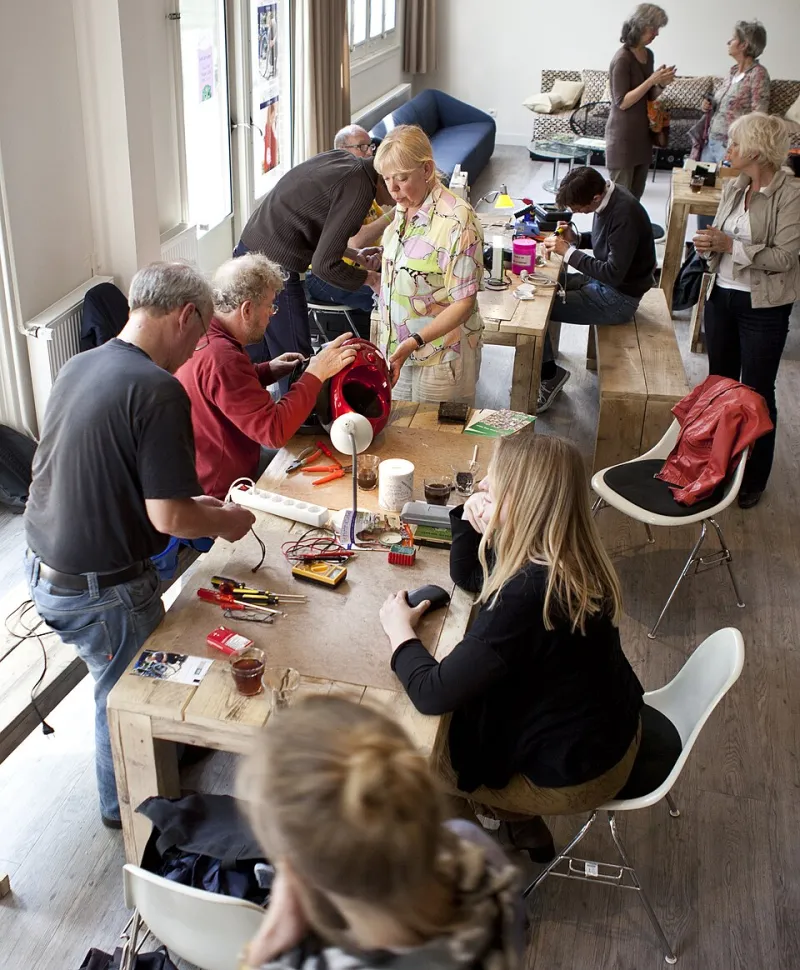
Photo: Ilvy Njiokiktjien, CC BY-SA 3.0, via Wikimedia Commons
It's ten past ten on a wet Saturday and the church hall smells of instant coffee and hot solder. There's a queue. Not a dramatic one — six or seven people, mostly holding something broken — but a queue all the same.
At the front, a woman is explaining that the kettle boils for four seconds and then gives up. Behind a trestle table, a retired electrician called Ray is doing something with a multimeter and listening with the particular patience of a man who has seen this exact fault two hundred times before.
This is a repair café. They exist in church halls, community centres, libraries and scout huts all over the UK, and they are quietly one of the better ideas of the last decade.
What actually happens
You arrive with your busted thing. Somebody books you in, writes your name and the item on a sheet, and points you at a table. A volunteer has a look. Sometimes it's a fuse, a fused plug, a worn belt, a broken zip, a loose wire, a dead capacitor that costs forty pence.
Sometimes it's not fixable. That happens perhaps half the time, depending on what people bring and how skilled the volunteers are. The honest ones will tell you straight away.
Then there's the waiting. And the waiting, if we're being frank, is the actual product. You sit next to a stranger with a broken lamp. You get talking. Someone's grandson has just started school. Someone's husband died in the spring. Someone is trying to work out how to use the council's new bin booking system and a woman at the next table knows the trick.
Forty minutes pass. The kettle lives again. There is a small round of applause, which sounds daft written down and isn't.
Skills nobody taught you on purpose
There's a whole vocabulary in these rooms that used to be common property. Darning. Re-soldering a joint. Checking continuity. Replacing a plug, correctly, with the right fuse. Sharpening shears. Oiling a sewing machine. Re-hemming a curtain. Knowing the difference between something that's dead and something that's just sulking.
Some of it came down through families. A lot of it didn't, because the curriculum moved on and the repair shops closed and everything got cheaper to replace than to mend.
What's striking in 2026 is that it flows both ways. Older volunteers teach the fine motor stuff — how to hold a soldering iron, how to coax a stiff mechanism. Younger ones teach the modern bits: lithium batteries, firmware updates, why the app won't talk to the thermostat. Nobody is the expert in the room.
What mending does to your head
There's a reason repair cafés are increasingly being folded into social prescribing and wellbeing strategies. The evidence isn't just anecdotal, though the anecdotes are strong.
Fixing something gives you agency — a small, concrete, provable win. In a week of emails and forms and things-you-can't-control, that's not nothing. Learning in front of other people, at your own pace, without an exam at the end, is a rare kind of permission. And the mild absorption of a fiddly task is about as close to a guaranteed mood lift as anything gets.
Then there's the connection. Loneliness is expensive — for the person and for the state — and the standard remedies (a coffee morning, a group walk) don't suit everyone. A repair café asks nothing of you but a broken object and a bit of patience. You can be shy and still take part. You can be new to the area and still have a reason to be in the room.
Men, in particular, seem to find it easier than most social settings. There's a task to look at. Nobody is required to make eye contact.
The awkward truths
It would be dishonest to pretend it's all toasters and triumph.
Some things shouldn't be repaired by volunteers — anything involving gas, microwaves, or a mains appliance with a fault you can't fully diagnose. Good groups have clear rules and turn those away. Portable appliance testing matters, and so does public liability insurance. Electrical competence is not the same as enthusiasm.
Not everything is fixable, and a few things are better recycled than rescued. The best cafés have a relationship with the local household waste site and know where the e-waste actually goes.
And every group needs someone doing the admin. The coordinator is the least glamorous role and the one most likely to burn out. Rotate it.
Finding one near you
The Repair Café Foundation maintains a directory of UK groups at repaircafe.org, and The Restart Project runs pop-up Restart Parties, mainly in cities, with a strong focus on electronics. Repair Café Wales has been particularly effective at seeding groups; there are active networks in Scotland and Northern Ireland too. Beyond that, ask at the library, check the parish newsletter, or search your town name plus the word repair — most groups are small enough that word of mouth still beats search engines.
Starting one: a short, honest checklist
Find a venue with good lighting, level access, plenty of sockets and a hall fee you can cover. Sort public liability insurance before your first session, not after. Recruit four to six volunteers with genuinely different skills and one person willing to coordinate. Buy a PAT tester and learn to use it. Write down what you won't attempt. Set up a simple booking sheet. Agree a tea rota — this is not a joke, the tea rota is load-bearing.
Start small. Two hours, one Saturday a month, six items. Advertise through the school, the GP surgery, the mosque, the church, the community Facebook group that everyone claims to hate and everyone reads. Don't promise savings. Promise a decent morning.
The point isn't the kettle
Back in the hall, the woman with the kettle is being shown what went wrong. She's not really listening. She's telling Ray about her sister's microwave.
Two tables over, a teenager is learning to thread a sewing machine from a woman who has been doing it since 1971. Somewhere in the corner, a man is eating a biscuit and looking, for the first time in weeks, like he has nowhere else he needs to be.
The kettle works. That's nice. The rest is better.